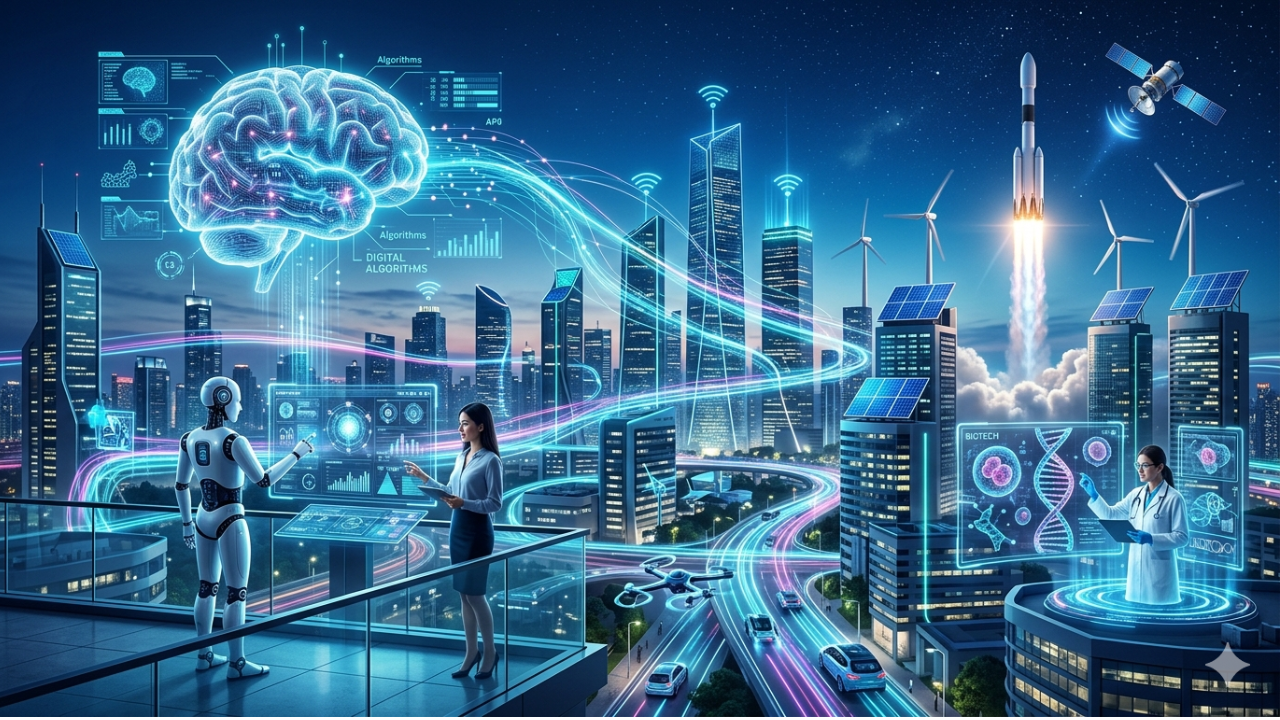
Imagine waking up in 2030 to a world where your doctor diagnoses illness before you feel a single symptom, your city adjusts its traffic lights in real time to cut your commute in half, and clean energy powers everything you own. This isn’t science fiction — it’s the trajectory of the technology trends next 5 years that are already in motion today. Whether you’re a business owner, a curious professional, or simply someone who wants to understand what technology will look like in 5 years, this guide breaks it all down in plain language. Here are the ten most transformative trends you need to know about.
1. Artificial Intelligence Moves from Tool to Co-Worker
The artificial intelligence future impact is no longer theoretical. AI has already reshaped search engines, customer service, and content creation — but what’s coming next is a dramatic leap forward.
Within five years, AI agents won’t just answer questions; they’ll autonomously manage projects, conduct research, and make business decisions. Think of tools like OpenAI’s GPT-based systems or Google’s Gemini evolving into fully autonomous “co-workers” capable of executing multi-step tasks without human supervision.
What this means for you:
- White-collar jobs in law, finance, and marketing will be augmented (not necessarily replaced) by AI assistants
- Small businesses will access capabilities that once required entire departments
- Personalized education powered by AI will adapt in real time to each student’s learning pace
This is arguably the most wide-reaching of all the future technology trends — because it amplifies the impact of every other trend on this list.
2. Quantum Computing Crosses Into Real-World Application
For years, quantum computing has lived in the lab. By 2030, quantum computing future applications will start solving problems that today’s most powerful supercomputers simply cannot crack.
Companies like IBM, Google, and IonQ are racing to achieve “quantum advantage” — the point at which quantum machines outperform classical computers on commercially relevant tasks. Early use cases are already emerging in drug discovery, financial risk modeling, and logistics optimization.
In five years, expect quantum computing to turbocharge AI training, break current encryption standards (prompting a global shift to quantum-safe cryptography), and accelerate materials science breakthroughs that feed into clean energy technology.
3. Biotechnology Innovations Redefine Medicine
Among the most profound innovations changing the world, biotechnology stands out for its direct impact on human health and longevity.
CRISPR gene editing, mRNA vaccine platforms, and AI-driven drug discovery are converging to create a new era of precision medicine. In practical terms:
- Cancer treatments tailored to an individual’s exact genetic profile are entering clinical trials now
- mRNA technology — proven effective through COVID-19 vaccines — is being applied to HIV, tuberculosis, and even some cancers
- Wearable biosensors will monitor blood glucose, cortisol, and cardiac markers continuously, sending alerts before a crisis develops
Biotechnology innovations 2025 are setting the stage for a decade where chronic disease management becomes proactive rather than reactive. For everyday people, this means fewer hospital visits and longer, healthier lives.
4. Renewable Energy Technology Reaches a Tipping Point
Renewable energy technology trends are accelerating faster than even optimistic forecasts predicted five years ago. Solar, wind, and battery storage costs have plummeted — and the next wave of innovation will make clean energy not just affordable but dominant.
Key developments to watch:
- Solid-state batteries promise energy density far beyond lithium-ion, enabling longer-range EVs and grid-scale storage
- Green hydrogen is maturing as a fuel source for heavy industry and shipping
- Next-generation nuclear (small modular reactors) is attracting serious investment from governments and tech giants alike
By 2030, renewable energy won’t just be the ethical choice — it will be the cheapest choice in most markets. That economic reality will accelerate adoption at a pace no policy alone could achieve.
5. Smart Cities Technology Transforms Urban Living
Smart cities technology is one of the most visible examples of technology shaping the future in ways that affect daily life directly.
Sensors embedded in roads, buildings, and public transit systems are already generating mountains of data in cities like Singapore, Amsterdam, and Songdo in South Korea. Over the next five years, AI will learn to act on that data in real time:
- Traffic systems that reroute vehicles dynamically to eliminate congestion
- Smart grids that balance electricity demand across neighborhoods automatically
- Predictive maintenance systems that fix water pipes before they burst
For residents, this translates to cleaner air, faster commutes, lower utility bills, and safer streets. The city itself becomes an intelligent system working on your behalf.
6. Robotics and Automation Enter Everyday Spaces
Robotics and automation future developments are moving well beyond the factory floor. The next five years will see robots operating in hospitals, warehouses, restaurants, construction sites, and homes.
Boston Dynamics, Figure AI, and a wave of startups are developing humanoid robots capable of performing physical tasks in environments designed for humans. Meanwhile, surgical robots like the Da Vinci system are becoming more autonomous and affordable.
This isn’t just about job displacement — it’s about augmentation. Robots handling dangerous or repetitive tasks free human workers to focus on creativity, empathy, and complex problem-solving. Disruptive technologies examples don’t get more tangible than a robot that stocks your grocery shelves overnight and a surgical assistant that operates with sub-millimeter precision.
7. The Spatial Internet: AR, VR, and Mixed Reality Go Mainstream
Augmented and mixed reality have been “five years away” for a decade — but the hardware has finally caught up with the ambition.
Apple’s Vision Pro, Meta’s Ray-Ban smart glasses, and a growing ecosystem of enterprise AR tools signal that spatial computing is entering its practical phase. Over the next five years:
- Architects and engineers will design in fully immersive 3D environments
- Surgeons will overlay real-time imaging data during complex procedures
- Remote workers will collaborate in shared virtual spaces that feel genuinely present
This is one of the next big technological breakthroughs that most people haven’t fully grasped yet — partly because you need to experience it firsthand to understand the shift it represents.
8. Cybersecurity Evolves Into an AI Arms Race
As technology becomes more embedded in critical infrastructure, the stakes of cybersecurity rise dramatically. The future of digital security is an AI-driven arms race between defenders and attackers.
How technology will change our lives by 2030 in this domain is sobering: AI-generated deepfakes, automated phishing at scale, and AI-powered malware will make today’s threats look primitive. But defensive AI will evolve in parallel — detecting anomalies, predicting attack vectors, and responding in milliseconds.
For individuals, this means:
- Biometric authentication replacing passwords entirely
- AI-monitored personal accounts that flag unusual activity instantly
- National-level “cyber immune systems” protecting critical infrastructure
9. Brain-Computer Interfaces Blur the Line Between Mind and Machine
Perhaps the most philosophically striking of all emerging technologies 2025 and beyond, brain-computer interfaces (BCIs) are moving from medical necessity to broader application.
Neuralink’s early human trials demonstrated that paralyzed patients could control computers with their thoughts. Within five years, non-invasive BCIs — worn as headsets rather than implanted — will allow healthy users to control devices, communicate faster, and even experience immersive digital environments directly.
The future innovations that will impact daily life most profoundly may well include a generation that uses thought-based interfaces the way we currently use touchscreens — as a natural, intuitive extension of the self.
10. The Biggest Technology Trends in the Next Decade: Convergence
Here’s the insight most forecasts miss: the biggest technology trends in the next decade won’t unfold in isolation. Their real power comes from convergence.
AI accelerates drug discovery (biotech). Quantum computing supercharges AI. Renewable energy powers smart cities. Robots become useful when connected to intelligent networks. BCIs interface with spatial computing environments.
Each breakthrough unlocks the potential of the others. The result isn’t ten separate revolutions — it’s one compounding transformation of how human civilization operates, creates, and solves problems.
Conclusion: The Future Is Nearer Than You May Imagine
The technology trends next 5 years outlined here aren’t distant possibilities. They’re already funded, already in development, and in many cases already producing results. The question isn’t whether these changes are coming — it’s how prepared individuals, businesses, and governments will be when they arrive.
The most productive response isn’t anxiety. It’s curiosity. Understanding these shifts early gives you the rare advantage of positioning yourself — professionally, financially, and intellectually — ahead of the curve. Stay informed, stay adaptable, and remember: the people who thrive in technological transitions are rarely the ones who built the technology. They were the first to grasp it.
Frequently Asked Questions
Q: What are the most important technology trends next 5 years to watch?
Artificial intelligence, quantum computing, biotechnology, renewable energy, and smart cities technology are widely regarded as the five most consequential trends shaping the next half-decade. Their convergence will amplify their individual impact significantly.
Q: How will technology change our lives by 2030?
By 2030, most people will interact with AI daily in work and healthcare, live in smarter urban environments, benefit from personalized medicine, and use renewable energy as the default. The changes will feel gradual day-to-day but dramatic in retrospect.
Q: Are robotics and automation going to eliminate jobs? The evidence suggests
The evidence suggests automation eliminates specific tasks more than entire jobs. As old roles change, new ones appear. The net effect on employment depends heavily on how quickly education and training systems adapt — which is itself a major policy challenge.
Q: What are some real-world disruptive technologies examples right now?
CRISPR gene therapy in clinical use, AI-generated code tools like GitHub Copilot, solid-state battery prototypes from Toyota and Samsung, humanoid robots in warehouse trials, and Neuralink’s human BCI implants are all live, real-world examples of disruption in progress.
Q: How can I prepare for future technology trends?
Focus on skills that complement AI rather than compete with it — critical thinking, creativity, emotional intelligence, and cross-disciplinary problem-solving. Stay curious about emerging fields, and don’t wait for change to arrive before adapting to it.



The shift toward AI as a co-worker rather than just a tool is genuinely exciting and a bit overwhelming at the same time. It really highlights how deeply AI will integrate into our professional lives, especially in fields like law and finance. I’m curious to see how this evolution will reshape workplace dynamics and what skills people will need to stay relevant.
The shift toward AI as a co-worker rather than just a tool is genuinely exciting and a bit overwhelming at the same time. It really highlights how deeply AI will integrate into our professional lives, especially in fields like law and finance. I’m curious to see how this evolution impacts job roles and what new skills people will need to stay relevant. Thanks for breaking this down so clearly.
The distinction between AI as a tool versus an autonomous ‘co-worker’ is a crucial shift that truly defines the next five years, especially regarding how white-collar roles will evolve. It’s fascinating to consider how this transition will force businesses to rethink project management and decision-making processes rather than just focusing on automation. This shift from assistance to full execution seems like the biggest challenge and opportunity on the horizon.
Hey There. I found your blog using msn. This is an extremely well written article. I will make sure to bookmark it and come back to read more of your useful information. Thanks for the post. I will definitely return.
Exploring feature equilibrium becomes straightforward using digital imaging utilities. Utilizing a free face balance score test provides clear metrics regarding personal facial proportions.
Clear and natural narration keeps audiences focused on video content. Implementing a realistic voice speech tool for youtube grants access to varied voice styles suitable for educational tutorials and narrative content.
Building robust multi-step automation relies on structured task distribution patterns. Utilizing established orchestration procedures for autonomous ai agents ensures background operations complete predictably without getting stuck in execution loops.
When collaborating on campaign materials, testing the ReWords AI image tool can help team members adjust visual copy. It is intended to assist designers during fast-paced creative reviews.
Preventing costly cosmetic damage requires precise tool control and protective plastic shims. It is helpful to learn how to avoid vehicle damage during lockout to learn practical techniques for paint protection.