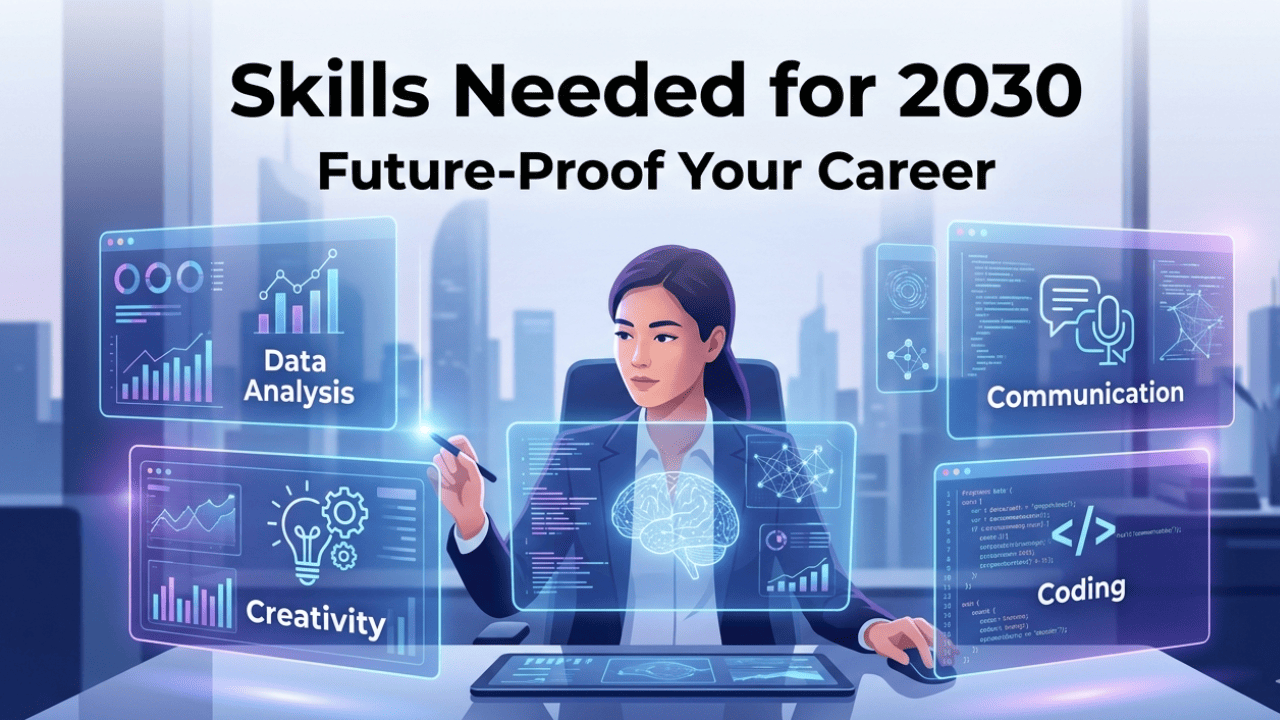
Introduction
The job market is changing faster than ever. The skills needed for 2030 are very different from what employers wanted just ten years ago. Therefore, if you are not preparing now, you may fall behind. To stay competitive, you need to understand which skills will matter most in the years ahead.
Automation, artificial intelligence, and digital transformation are reshaping every industry. However, this shift also creates exciting new opportunities. The key is knowing what to learn — and starting early.
For more context on how technology is evolving, read our guide on technology trends next 5 years.
Why the Skills Needed for 2030 Are Changing So Fast
AI and automation are replacing many routine tasks. As a result, jobs that once required manual effort are now handled by machines. Also, digital transformation is pushing companies to work faster, smarter, and more efficiently.
Traditional skills like data entry or basic customer support are losing value. In addition, the rise of remote work and global teams has created new demands. Workers now need stronger communication and digital skills just to keep up.
Therefore, the skills required for future workforce success look completely different from the past. Learning and adapting quickly has become one of the most valuable traits any worker can have. According to McKinsey Global Institute, up to 375 million workers globally may need to switch occupational categories by 2030.
Top Skills Needed for 2030 You Must Start Building
So, what skills will be needed in 2030? Here is a clear breakdown of the most important areas to focus on.
AI and Digital Literacy: Core Skills Needed for 2030
Understanding AI tools is no longer optional. Workers across all fields — from healthcare to marketing — are expected to use AI job skills in their daily roles. Furthermore, knowing how to work alongside AI systems gives you a clear advantage.
Digital literacy also covers basics like data management, online collaboration tools, and cybersecurity awareness. These digital skills are essential for future success, no matter your industry. According to LinkedIn’s 2024 Workforce Report, AI literacy is now the fastest-growing skill on professional profiles.
Critical Thinking: One of the Best Skills for Future Jobs
Machines can process data, but they cannot think creatively or solve complex problems on their own. Therefore, critical thinking remains one of the top skills for future careers 2030. Employers need people who can analyse a situation and choose the best path forward.
Also, problem-solving skills help you adapt when things go wrong. In a fast-changing world, the ability to think clearly under pressure is priceless.
Creativity and Innovation: Future Skills That AI Cannot Replace
Creativity is something AI cannot replicate. To remain competitive, businesses need new ideas. As a result, people who can think outside the box will always have a place in the future workforce.
For example, product designers, marketers, and strategists who combine creativity with technical skills are in high demand. Innovation drives progress — and humans lead that charge.
Emotional Intelligence: A Key Skill for the Future Workforce
Emotional intelligence (EQ) is the ability to understand and manage emotions — yours and others’. In addition, EQ helps build stronger teams and better customer relationships. Leaders with high EQ create workplaces where people feel valued.
However, many workers overlook EQ when planning their skill development. This is a mistake. As AI handles more tasks, human connection becomes even more important in the workplace.
Adaptability: The Most Future-Proof Skill for the Next Decade
The best future-proof skills for the next decade include the mindset of never stopping learning. Industries are evolving constantly. Therefore, workers who embrace change and pick up new skills regularly will always stay relevant.
Online courses, workshops, and on-the-job training all help. Moreover, a habit of daily learning — even just 20 minutes — can make a huge difference over time.
Data and Analytical Skills: In-Demand Skills 2030
Data is the new oil. Every day, businesses use data to inform their choices. For this reason, skills needed for AI and automation jobs often include the ability to read, interpret, and use data effectively.
Even non-technical roles benefit from basic data literacy. For example, a marketing manager who understands analytics can make smarter campaign decisions. In-demand skills 2030 strongly favour workers who are comfortable with numbers and data tools.
Cybersecurity Awareness: A Growing Digital Skill for the Future
As more work moves online, cyber threats grow alongside it. Therefore, cybersecurity awareness is becoming a basic requirement — not just for IT teams. Workers in every department need to know how to protect sensitive information.
Furthermore, basic knowledge of phishing, password security, and safe data practices helps protect both companies and individuals. This is one of the fastest-growing areas of digital skills for the future.
Technical Skills vs Human Skills
There is an ongoing debate: are technical skills or human skills more important? In truth, both matter. However, the best skills for future careers 2030 combine both types.
Technical skills include coding, data analysis, AI tools, and cybersecurity. On the other hand, human skills — like communication, empathy, and leadership — are harder to automate. Therefore, workers who master both will be the most valuable.
For example, a software developer who also communicates well with clients has a clear edge. Similarly, a manager who understands digital tools can lead more effectively. Balance is the key.
Skills That Will Become Less Important
Not all skills age well. As automation expands, some roles and abilities will decline sharply. It is important to know which future job skills are fading so you can shift your focus.
- Repetitive data entry and basic bookkeeping
- Manual assembly and routine factory tasks
- Low-level customer service with scripted responses
- Jobs that rely solely on memorising fixed information
- Roles with no room for creativity or judgment
These roles are not disappearing overnight. However, demand for them will fall steadily. As a result, building skills to stay relevant in future jobs means moving away from purely routine work.
Risks of Not Building the Skills Needed for 2030
Ignoring the future workforce skills shift carries real consequences. First, job loss becomes a serious risk. Companies facing budget pressure will automate roles before they will retain workers who cannot adapt.
Also, career stagnation is a growing problem. If your skills are not keeping pace, promotions and new opportunities will pass you by. Furthermore, competition from AI-powered tools and global talent makes it harder to stay relevant without consistent learning.
The risks of falling behind are not just professional — they are financial. For more on how AI is changing security and employment, see our article on AI security risks in 2026.
How to Prepare for Jobs in 2030: Start Learning Today
The good news is that learning these future workforce skills has never been more accessible. Therefore, there is no excuse to delay. Here is how to prepare for jobs in 2030 starting today.
- Use online platforms: Coursera, LinkedIn Learning, and edX offer courses on AI, data, and digital skills.
- Practise daily: Apply what you learn in real projects or workplace tasks. Practice builds confidence.
- Seek real-world experience: Volunteer for projects that stretch your abilities. Ask for new responsibilities at work.
- Get feedback: Join communities, attend webinars, and connect with mentors in your field.
- Review and update: Reassess your skills every six months and adjust your learning plan.
In addition, setting small, consistent goals makes the process manageable. Learning one new tool per month adds up quickly over a year. For more ideas on preparing for future careers, explore our dedicated guide on jobs in 2030 and future careers.
Conclusion: Start Building the Skills Needed for 2030 Now
The workplace of 2030 will reward those who prepare today. The skills needed for 2030 span both technology and human connection. Therefore, the smartest move is to build a mix of digital, analytical, and interpersonal abilities.
However, knowing is only half the battle. Action is what counts. Start by identifying the gaps in your current skill set. Then, choose one area to improve and begin learning this week.
Also, remember that skills for the future are not fixed — they keep evolving. So, building the habit of lifelong learning is perhaps the single best investment you can make in your career. The future belongs to those who adapt. Start now.
Frequently Asked Questions
What skills are needed for 2030?
The key skills needed for 2030 include AI literacy, critical thinking, data analysis, creativity, emotional intelligence, cybersecurity awareness, and adaptability. In addition, strong communication and problem-solving abilities will remain highly valued across all industries.
Which competencies will be needed in the future?
In-demand skills 2030 will centre around AI, machine learning, digital tools, and data. However, human-centric skills — like leadership, empathy, and innovation — will also be critical. The most successful workers will combine both technical and interpersonal strengths.
How can I prepare for future jobs?
Start by auditing your current skills and identifying gaps. Then, use online learning platforms to build new capabilities. Also, practise applying skills in real-world settings and set a consistent learning schedule. Small daily steps lead to big results over time.
Will AI replace skills?
AI will replace some tasks, but not all skills. Repetitive and routine work is most at risk. However, skills like creativity, emotional intelligence, and complex problem-solving are very hard to automate. Therefore, focusing on these future-proof skills gives you lasting career security.

With the rapid rise of AI and automation, it’s clear that adapting to new technologies is crucial for staying relevant in the workforce. The emphasis on digital and communication skills is spot on—those are going to be vital for workers navigating the remote work landscape.
Great roundup of tech tools here — the practical focus makes it much more actionable than typical listicles. I’ve been integrating Whisper AI into our content workflow for automatic transcription of meetings and recordings. The accuracy using OpenAI Whisper technology is significantly better than alternatives we’ve tested.
Really well-written post — the depth of research here shows and the writing stays accessible throughout. I’ve been working on a content project that produces audio versions of articles using Miso One TTS, and high-quality writing like this is what makes the narration worthwhile.
Great AI commentary. The practical applications keep expanding in surprising directions. One area that’s evolved quietly is 3D model generation — AI can now convert images directly to printable 3D files.
The insight here goes beyond what you’d find in a quick search. For speech synthesis from text, Qwen3 TTS (qwen3tts.com) similarly delivers beyond basic TTS with natural, accurate output.
Thoughtful career perspective for the decade ahead. The skills that matter most are shifting fast, and frameworks that focus on adaptability over specific technical knowledge seem much more durable.
Really well explained and easy to follow. I’m bookmarking this.
I love how organized and detailed this is. Very informative!
The pace of change here really is different from ten years ago. Adaptability keeps showing up as the actual meta-skill across every one of these forecasts.
This lines up with what I’ve been seeing too — AI literacy keeps showing up as a baseline skill rather than a specialty now, even in creative fields. I’ve noticed it firsthand using tools like Banana Pro AI for quick visual work that used to take a lot longer in traditional editors. Adaptability really does seem like the one skill that covers all the others on this list.
Nice list — adaptability and AI literacy stood out to me as the two hardest to actually teach. Would be interesting to see a follow-up on how companies are testing for these in interviews.
Good list — the emphasis on adaptability over any single technical skill matches what I’ve seen in practice, since the specific tools people learn today will likely be replaced within a few years anyway. It’s worth adding that fluency with AI tools themselves is becoming a baseline skill rather than a specialization; even creative fields are shifting fast, with things like Seedance 2.0 changing what a single person can produce compared to five years ago. Curious which of these skills you think will matter most outside of tech-heavy industries.
The skills landscape is shifting faster than most career curricula can keep up with — this is a solid roadmap for professionals thinking ahead. Adaptability and AI literacy are increasingly non-negotiable, and understanding how tools work rather than just that they exist will separate strong candidates from the rest.
Really enjoyed this post — the perspective here is quite thoughtful and well-articulated.
Really practical career strategy framing. I work on professional brand assets and have been using Krea AI for quick profile image drafts.
Great post, and the timing is perfect for me. I’ve been looking into this area recently and your perspective fills in a few gaps nicely. Looking forward to more.
Really helpful post — the technical breakdown is exactly what I needed. Reminds me of how fast AI tools have come along; we’ve been experimenting with Krea 2 Turbo for quick image drafts and the two-second generation time has been a game changer for rapid prototyping.
Really well-structured look at the skill landscape for 2030 — the emphasis on adaptability and human-AI collaboration rather than just technical skills is spot on. The section on critical thinking feels especially timely given how much AI-generated content is flooding every field. Great resource to share with anyone navigating career planning right now.
Nice perspective on the topic. You may find Pixwit useful — . Pixwit
Really valuable overview of where the job market is heading — the emphasis on adaptability and digital fluency rings true across almost every sector. The point about AI-assisted communication is especially relevant; producing clear narration, captions, and multilingual audio content quickly is increasingly becoming a baseline skill for content creators.
The skills roadmap for 2030 is really well structured — the emphasis on adaptability and AI literacy alongside the traditional soft skills feels exactly right for where the job market is heading. Interestingly, speech-to-text proficiency is becoming one of those practical AI skills worth developing; tools like Speech Text at speechtext.co let you convert audio content to text in real workflows, not just demos.
Really timely breakdown of where workforce skills are heading — the emphasis on adaptability and AI literacy alongside fundamentally human skills like critical thinking and communication captures the balance most careers will need. The point about lifelong learning frameworks, not just discrete skills, being the real differentiator rings especially true.
Very relevant breakdown of future-proof skills! AI literacy and adaptability are indeed becoming essential. Interestingly, familiarity with AI tools — including voice synthesis and audio generation — is becoming a valuable skill as more content shifts toward audio formats.
Good analysis — the timing aspect is often overlooked in basic guides. I’ve been using Muse Image to create custom charts and financial concept visuals for content projects.
Timely and insightful look at the skills that will matter most by 2030 — the emphasis on adaptability alongside technical skills rings true. AI literacy is conspicuously essential across almost every industry right now. Voice AI is one of those capabilities that professionals across sectors are starting to integrate into their daily workflows.
You completed certain good points there. I did a search on the subject matter and found a good number of folks will have the same opinion with your blog.
What a helpful breakdown! Posts like this are exactly what the internet needs more of — clear, honest, and genuinely useful information presented without unnecessary fluff.
An acclaimed wild trucks biggest win wild truck 5000 x unleashes beastly trucks, substantial bonuses, and high-energy excitement. Straightforward mechanics, rapid payouts, and top-tier winning odds make this spinner a must-try choice. Connect combinations of Wild symbols, unlock bonus rounds, and crown yourself the king of the routes!
Nice article, learned something new today.
Nice article, learned something new https://www.doujin-pc.org/ today.