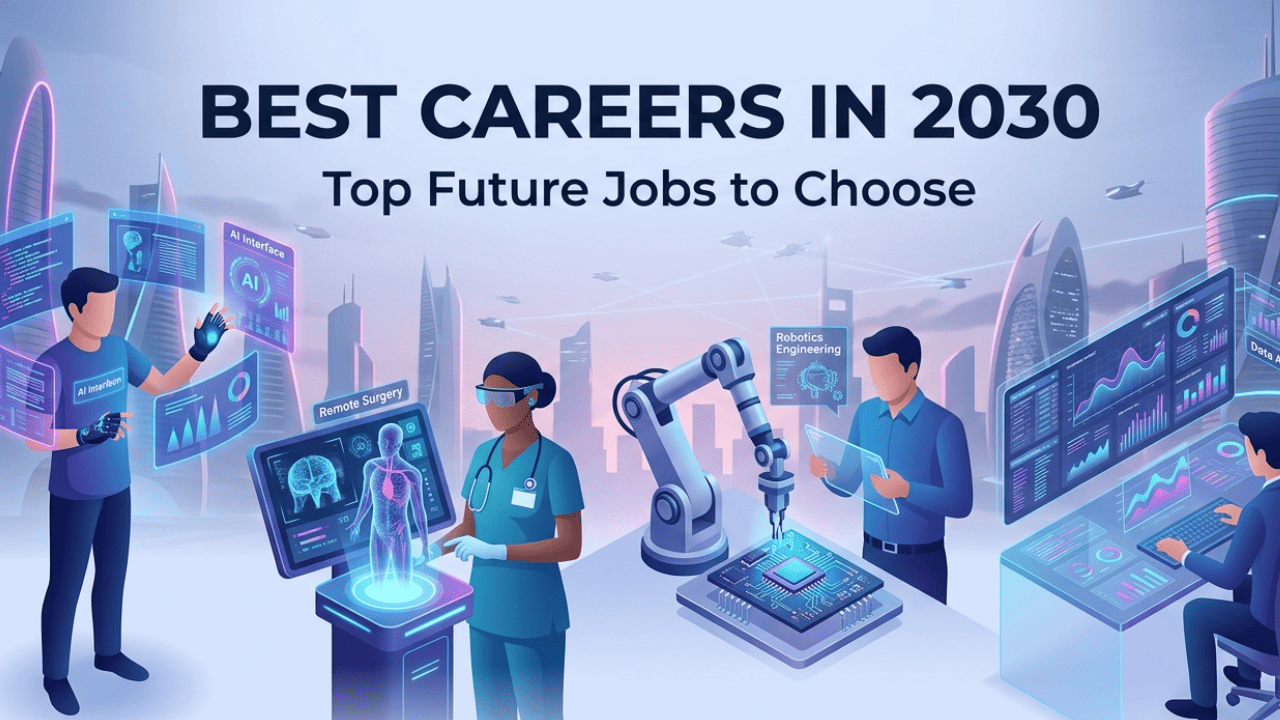
Introduction
The world of work is shifting faster than ever before. Every sector is changing due to automation, artificial intelligence, and digital transformation. As a result, the choices you make today could define your financial future for decades.
So, what are the best careers in 2030? Now more than ever, that question is important. Traditional career paths – once considered safe – are losing ground. Meanwhile, new, high-demand roles are emerging across tech, healthcare, and clean energy.
In this guide, you’ll discover the top jobs in 2030, the skills you’ll need, and how to position yourself ahead of the curve. Understanding the technology trends next 5 years will help you see why these careers are rising so fast.
Why Career Choices Are Changing So Fast
Technology is no longer just disrupting business – it’s disrupting employment itself. According to the World Economic Forum’s Future of Jobs Report, over 85 million jobs could be displaced by automation in the coming years. Therefore, roles built around repetition or routine are fading quickly.
Digital transformation is accelerating across sectors like finance, retail, education, and logistics. Companies are investing heavily in automation to cut costs and boost efficiency. As a result, workers who rely on manual, predictable tasks face real risk.
However, this disruption also creates opportunity. For every role that disappears, several new ones appear. The key is knowing which direction to move before the tide turns.
Best Careers in 2030
The following careers represent the most promising future career opportunities across industries. Each one is backed by strong demand, strong salaries, and long-term resilience.
AI and Machine Learning Careers
AI careers are among the fastest-growing in the world. Machine learning engineers, AI researchers, and prompt engineers are already in short supply. By 2030, that shortage will deepen significantly.
These roles involve building intelligent systems, training data models, and solving real-world problems with automation. In addition, companies in every sector – from healthcare to retail – are racing to integrate AI. Therefore, professionals with this skill set will command premium salaries and near-universal demand.
Healthcare and Biotechnology Careers
Healthcare remains one of the most secure careers for the future. Aging populations, chronic disease management, and biotech innovation are all fueling consistent growth. Jobs in this space include genetic counselors, biomedical engineers, and AI-assisted diagnosticians.
Biotechnology, in particular, is expanding rapidly. CRISPR research, personalised medicine, and drug development automation are creating entirely new roles. As a result, healthcare professionals who embrace technology will find themselves at the centre of tomorrow’s most important work.
Renewable Energy Careers
Climate change is pushing every government and corporation toward clean energy. Solar engineers, wind turbine technicians, and energy storage specialists are among the high paying jobs in the future 2030. Demand for these roles is expected to surge as green infrastructure investment grows worldwide.
For example, the International Energy Agency projects millions of new clean energy jobs by 2030. Moreover, these are roles that require physical, technical expertise – making them far harder to automate than desk-based positions.
Cybersecurity Careers
Every new connected device creates a new vulnerability. Cybercrime is growing at an alarming rate, and organisations desperately need experts to defend them. According to the Bureau of Labor Statistics, cybersecurity roles are among the fastest-growing jobs in the country, and that trend will only accelerate by 2030.
Furthermore, regulatory requirements around data protection are tightening globally. Companies that fail to protect user data face massive fines. Consequently, cybersecurity specialists will remain irreplaceable for the foreseeable future.
Data Science and Analytics Careers
Data is the new oil – but only if someone can refine it. Data scientists, business intelligence analysts, and machine learning specialists help organisations make smarter decisions. These are high demand jobs future workers should seriously consider.
In addition, data science roles are expanding beyond tech companies. Retailers, hospitals, government agencies, and financial firms all need professionals who can interpret complex data. The versatility of this career path makes it especially attractive.
Robotics and Automation Careers
Robots are entering warehouses, hospitals, restaurants, and construction sites. Someone has to design, program, and maintain them. Robotics engineers and automation technicians are among the best jobs for the future 2030, combining mechanical expertise with software skills.
Moreover, as the cost of robotic hardware falls, adoption will accelerate across small and mid-sized businesses. This creates a long-term pipeline of future job opportunities for anyone with robotics training.
Creative and Digital Careers
Interestingly, creativity is one area where humans still have a clear edge. UX designers, content strategists, digital marketers, and video producers are careers that AI cannot replace – at least not fully. Human nuance, cultural insight, and emotional intelligence remain irreplaceable in creative work.
Furthermore, demand for digital content continues to explode. Streaming platforms, social media, e-commerce, and online education all need skilled creators. So, if you have a creative skillset and digital literacy, your future looks bright.
For a broader future career opportunities list, explore this detailed breakdown of jobs in 2030 and future careers.
Careers That Will Decline
Not every career is built for the future. Some roles face serious disruption as technology advances. In particular, these are the jobs most at risk:
- Data entry and administrative clerks – software handles these tasks faster and cheaper
- Retail cashiers and bank tellers – self-service and digital banking are replacing them
- Basic customer service roles – chatbots and AI assistants are taking over routine queries
- Truck and delivery drivers – autonomous vehicles are advancing rapidly
- Routine manufacturing workers – robotic arms and automated lines are replacing repetitive tasks
These aren’t just predictions. Automation is already eliminating many of these positions. Therefore, transitioning away from these areas early is the smartest move.
Skills Needed for These Careers
Knowing which jobs that will grow in the next decade is only half the battle. You also need the right skills to compete. Fortunately, most in-demand skills fall into a few clear categories.
Technical skills include coding, data analysis, AI tools, and cybersecurity fundamentals. Adaptability – the ability to learn new tools quickly – is equally important. In addition, communication and critical thinking remain highly valued across all sectors.
Soft skills matter more than ever in a world full of automation. Employers want problem-solvers who collaborate well and think creatively. Therefore, developing both technical and interpersonal skills gives you a real competitive edge.
For a detailed breakdown of what to learn now, check out this guide on skills needed for 2030.
How to Choose the Right Career for 2030
Choosing a future-proof career starts with honest self-assessment. First, consider what genuinely interests you. Passion sustains effort – and effort drives mastery. A career you enjoy will keep you motivated through years of learning and change.
Next, align your interests with market demand. Use job market data, industry reports, and growth projections to validate your direction. The best future jobs sit at the intersection of personal interest and real-world need.
Finally, evaluate your current skills and identify the gap. Most top careers require specific qualifications or certifications. However, many of these can be earned online in 12 to 24 months. Starting today puts you ahead of those who wait.
Future Work Trends and Opportunities
The way we work is also changing – not just what we do. Remote work has become a permanent feature of many industries, especially in tech and digital careers. As a result, geography no longer limits your career options the way it once did.
The gig economy is also expanding. More professionals are choosing freelance, project-based work over traditional employment. This shift offers flexibility but also demands strong personal branding and financial planning.
Perhaps most significantly, human-AI collaboration is becoming the norm. Workers who know how to use AI tools effectively will outperform those who resist them. In short, the future belongs to people who adapt alongside technology – not those who compete against it.
Conclusion
The careers landscape of 2030 will look very different from today’s. Automation, AI, and digital transformation are already rewriting the rules. However, this creates genuine opportunity for those willing to plan ahead.
The best careers in 2030 share common traits: they require human judgment, adapt to new technology, and sit in high-growth sectors. From AI engineering to renewable energy, the door is wide open – but only for those who prepare now.
Don’t wait for the employment market to shift. Choose your direction, build your skills, and take deliberate steps toward a future-proof career. The decisions you make today could define the next three decades of your working life.
Frequently Asked Questions
What are the best careers in 2030?
The best careers in 2030 include roles in AI and machine learning, cybersecurity, data science, renewable energy, healthcare, robotics, and digital creative fields. These roles combine high demand with strong salaries and long-term job security.
Which careers will be in demand in the future?
Careers in demand in the future include AI engineers, cloud architects, biomedical researchers, solar energy technicians, UX designers, and cybersecurity analysts. These fields are growing fast and show no sign of slowing down.
What jobs will grow the most by 2030?
Jobs in AI, clean energy, healthcare technology, and data science are projected to grow the most by 2030. Each of these sectors is driven by powerful, long-term forces including climate policy, digital transformation, and an ageing population.
How do I choose a future-proof career?
Start by identifying careers that align with your interests and match strong market demand. Then assess the skills required and create a clear learning plan. Prioritising adaptability – the ability to keep learning – is the single most important trait for long-term career success.


Clear and useful tips here. One tool I use for AI songs is TextSong: . TextSong
Solid write-up — learned a lot. Worth trying Van Gogh Free AI Video Generator — for free AI video generation.. Van Gogh Free AI Video Generator
مقال رائع! محمّل يوتيوب مجاني: SaveYT — . SaveYT
yldvvdmuledksjtupypgrxnrqrzpuv
nkhwqzufktwsynvgtjkxuuifvkemvx
Solid write-up — learned a lot. Worth trying The Choicer Voicer — for 98+ free browser voice games.. The Choicer Voicer
Saved as a favorite, I really like your blog!
Gracias por compartir. Útil: Luna Lisa Alpha en . Luna Lisa Alpha
มีประโยชน์ Swift-image (/) text-to-image และแก้ไขหลายรูป Swift-image
Great article, thanks for sharing! For cinematic AI video I recommend MiniMax H3 Video Generator: /. MiniMax H3 Video Generator
Gracias por compartir. Útil: Muse Voice Transcribe en . Muse Voice Transcribe