Introduction
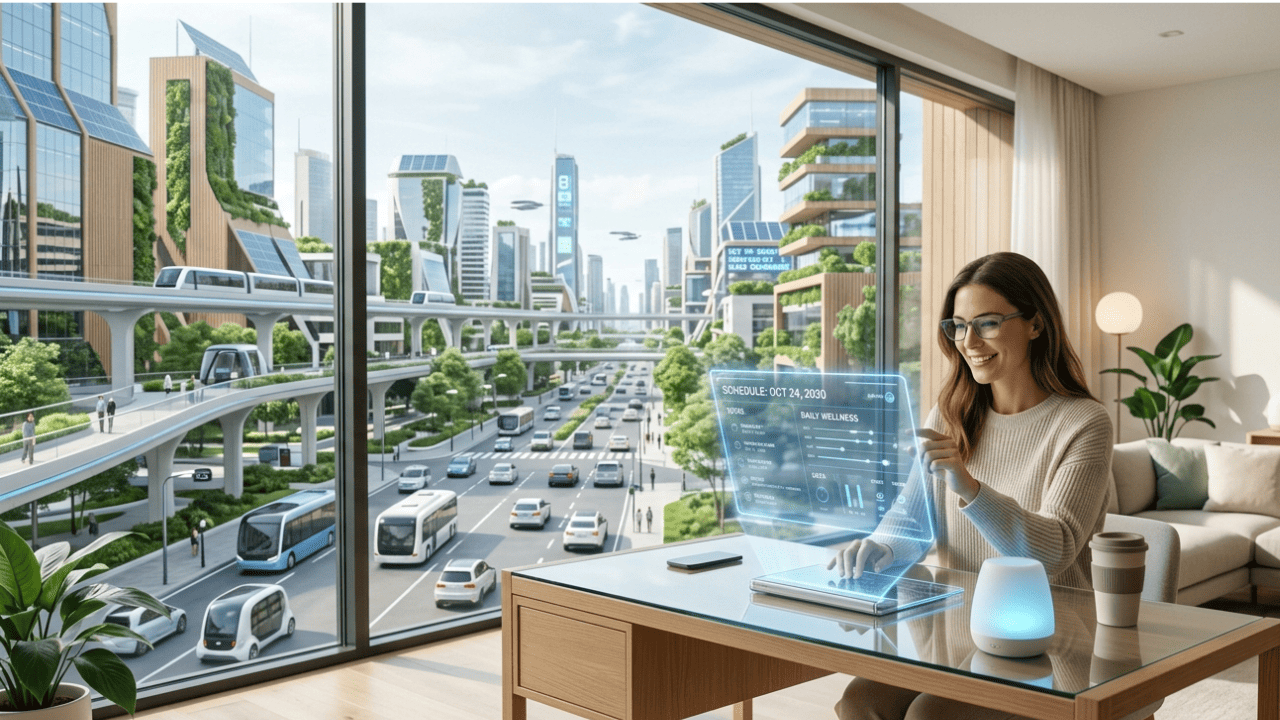
Imagine waking up in 2030. Your home already knows you’re awake. The lights adjust themselves. A calm AI voice reads your schedule while your coffee brews automatically. This is not science fiction. Life in 2030 is closer than most people think.
Over the next few years, AI, smart cities, and automation will reshape everything. From how we work to how we heal, change is coming fast. Understanding the technology trends next 5 years can help you prepare for what’s ahead.
What Will Daily Life Look Like in 2030?
Future life will feel deeply personal. Smart homes will learn your habits and adjust to your needs. Forgot to lock the door? Your home handles it. Too warm inside? The thermostat already knows.
AI assistants will go far beyond today’s voice apps. They will manage your calendar, suggest meals based on your health data, and even remind you to rest. Moreover, every experience – from shopping to entertainment – will feel tailored just for you.
Personalization will be everywhere. Streaming services will predict what you want before you search. Even grocery deliveries will adapt to your weekly routine. Life in the future will feel surprisingly intuitive.
Work and Jobs in 2030
The workplace is already changing. By 2030, many people will work alongside AI tools daily. These digital co-workers will handle repetitive tasks, crunch data, and generate reports in seconds.
However, this doesn’t mean fewer jobs overall. Instead, new roles will emerge. Think AI trainers, ethics officers, and automation managers. According to the World Economic Forum, millions of new tech-driven roles will be created by 2030. Therefore, adaptability will become the most valuable professional skill.
Some traditional roles will shrink. Others will grow rapidly. The smartest move anyone can make today is to stay curious and keep learning.
Healthcare in 2030
Future lifestyle improvements will show up most clearly in healthcare. AI will analyze symptoms faster than any human doctor can. Diagnosis times will drop dramatically. Furthermore, treatment plans will become highly personalized.
Wearable devices will track everything – your heart rate, sleep quality, stress levels, and blood oxygen. These devices will alert you before a health problem becomes serious. In fact, the World Health Organization already highlights digital health tools as a global priority. As a result, prevention will replace reaction as the main healthcare strategy.
Hospitals will still exist, but many checkups will happen from home. Smart sensors will send real-time data directly to your care team. Healthcare will become proactive, not just reactive.
Cities and Transportation in 2030
Smart cities will redesign urban living from the ground up. Streetlights will dim when no one is around. Waste systems will optimize collection routes automatically. Additionally, energy grids will balance supply and demand in real time.
Transportation will look different too. Autonomous vehicles will handle most daily commutes. Self-driving buses and taxis will operate 24/7 without a driver. Consequently, traffic accidents – often caused by human error – will decrease significantly.
City infrastructure will also become greener. Buildings will generate their own solar energy. Underground delivery networks will reduce street congestion. Living in a smart city will feel cleaner, faster, and safer.
Education and Learning in 2030
The classroom of 2030 will barely resemble today’s. AI tutors will identify each student’s weak spots and adjust lessons in real time. No two learning paths will look the same. Furthermore, students will learn at their own pace without falling behind.
Remote education will become immersive. Virtual reality classrooms will place students inside historical events or science experiments. Instead of reading about ancient Rome, a student can walk through it.
Lifelong learning will become the norm. Adults will regularly upskill through short, AI-guided courses. The line between school and work will blur in the best possible way.
Risks and Challenges of Life in 2030
Of course, future life won’t be without problems. Greater connectivity means greater vulnerability. Personal data will flow constantly between devices, cities, and corporations. As a result, privacy will become harder to protect.
AI itself carries real risks. Systems trained on flawed data can make biased decisions. Automated tools can be misused. For a deeper look at these dangers, read this important breakdown of AI security risks in 2026.
Cybersecurity threats will also grow more sophisticated. Hackers will target smart homes, hospitals, and power grids. Governments and companies will need to invest heavily in digital defense. Therefore, security awareness will become a basic life skill.
How to Prepare for Life in 2030
The best preparation starts now. Focus on skills that AI cannot easily replace – creativity, emotional intelligence, and critical thinking. These will remain highly valuable no matter how much technology advances.
Stay tech-aware without feeling overwhelmed. You don’t need to become an engineer. Still, understanding how AI tools work gives you a real advantage. Additionally, being open to change will serve you better than resisting it.
Build adaptability into your daily habits. Read broadly. Try new tools. Ask questions. The people who thrive in 2030 won’t necessarily be the smartest – they’ll be the most flexible.
Conclusion
The world is moving faster than ever before. Life in 2030 will look radically different from today – smarter, more connected, and more automated. Some changes will delight us. Others will challenge us deeply.
Even so, this future is not something that happens to us. We shape it with the choices we make today. Stay curious. Stay informed. Most importantly, stay open to the possibilities ahead.
The future lifestyle is being written right now. You get to help decide what it says.
FAQ
What will life be like in 2030?
Life in 2030 will be shaped by AI assistants, smart homes, autonomous vehicles, and personalized healthcare. Daily routines will feel more automated and efficient. However, human connection and creativity will remain central to a good life.
Will AI replace jobs by 2030?
AI will automate many repetitive tasks, but it won’t eliminate jobs entirely. Instead, it will reshape them. New roles will emerge in AI management, ethics, and design. Workers who adapt and upskill will have strong opportunities.,
How will technology change daily life?
Technology will make daily life more personalized and convenient. Smart devices will anticipate your needs. Healthcare will become preventive. Education will adapt to each individual learner. Overall, technology will save time and improve wellbeing.
Is future technology safe?
Future technology carries real risks, including data privacy issues and cybersecurity threats. However, with strong regulation, responsible AI development, and public awareness, these risks can be managed. Staying informed is your best defense.
I find it fascinating that by 2030, AI will play such a large role in both work and personal life. But with more reliance on technology, how will the workforce adapt to this shift? Will we need new skills, or is the focus more on collaboration with AI tools?
The vision of AI seamlessly integrating into daily routines, from smart homes to personalized AI assistants, really highlights how much our everyday lives will evolve by 2030. It’s fascinating to think about how predictive technology could make things like meal planning and home management so intuitive. This shift toward more adaptive and intelligent environments is something I’m genuinely excited to see unfold.
The idea of smart homes that proactively manage security and climate based on learned habits is a game-changer for daily convenience. It’s fascinating how the article shifts the focus from just automation to true personalization, where everything from meals to streaming feels intuitively tailored. This level of AI integration in the workplace mentioned at the end feels like the natural next step in that evolution.
The shift to hyper-personalized ecosystems described in the article is particularly fascinating, as it highlights how AI will move from a reactive tool to a proactive partner in daily living. It seems clear that by 2030, the definition of convenience will evolve from simply having access to technology to having a home environment that intuitively anticipates our needs before we even articulate them.
The vision of AI assistants managing everything from health data to daily schedules really hits home, especially regarding how personalized future experiences will feel without us even asking. It’s fascinating to think how quickly these smart home habits will evolve from simple conveniences into intuitive partners that anticipate our needs before we even realize them.
You actually make it seem so easy with your presentation but I find this topic to be actually something that I think I would never understand. It seems too complicated and extremely broad for me. I am looking forward for your next post, I will try to get the hang of it!